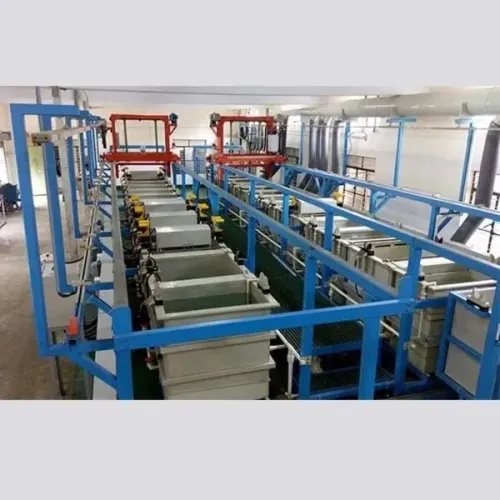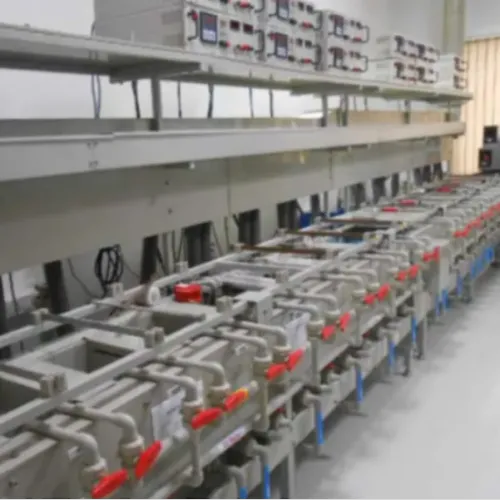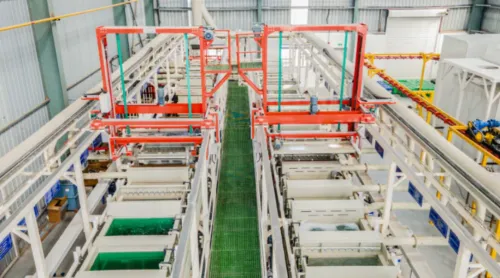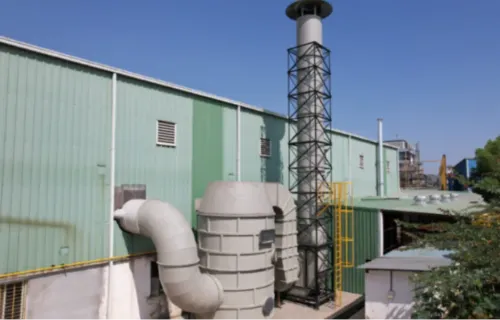
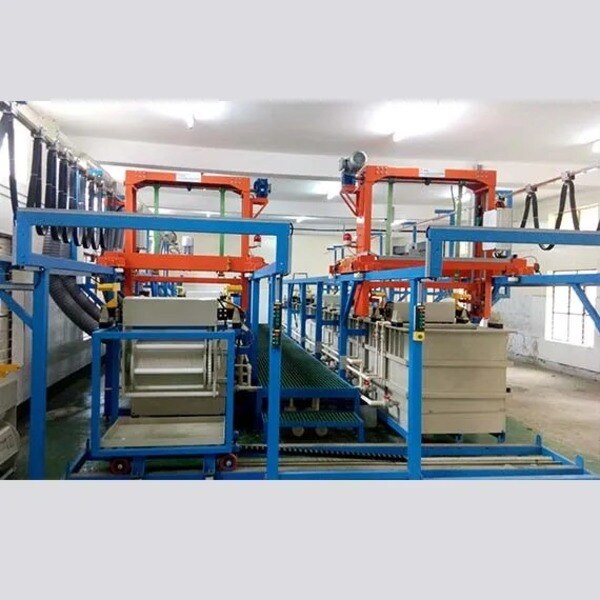
The answer depends on plated area, part consistency, coating requirements and plant utilization—not on the quoted equipment price alone. Use the framework below to compare decorative and hard-chrome systems, estimate total ownership cost, test technical suitability and decide whether internal plating beats outsourcing or another finish.
Key takeaways
- Calculate annual plated area before comparing nickel chrome plant quotations.
- Separate decorative nickel-chrome from industrial hard chrome requirements.
- Include wastewater treatment, ventilation, operators and compliance in total cost.
- Demand cycle-time trials, utility loads and acceptance criteria from suppliers.
Start with the production case, not the equipment quotation
Decide from annual plated surface area, part volume, product mix, utilization, cycle time, labour cost, rejection rate, required service life and outsourcing prices—not the quotation alone. Are nickel chrome plating plants worth it? Compare nickel and chrome plating plant cost with tanks, rectifiers, ventilation, scrubbers, wastewater treatment, maintenance, compliance, floor space and trained operators.
A high-throughput automated line becomes uneconomic at low utilization because those fixed costs remain while output falls. Estimate annual avoided outsourcing cost plus quality and lead-time savings, then subtract:
- Chemicals, electricity, water, drag-out, anodes, filters, sludge disposal, bath analysis, rework, downtime and maintenance.
- Approval, civil work, installation, bath make-up, qualification and post-commissioning stabilisation time.
Buy only when the resulting annual benefit supports the capital payback and demand is stable enough to keep the line loaded.
| Option | Best fit | Main trade-off |
|---|---|---|
| Nickel-chrome | Appearance, corrosion life and controlled dimensions | Multistage chemistry and wastewater burden |
| Zinc electroplating | Sacrificial corrosion protection at lower cost | Less decorative durability and wear resistance |
| Phosphating plus paint or powder coating | Large surfaces and flexible colours | Thicker film and possible chipping |
| Electroless nickel | Uniform coverage in recesses and bores | Higher chemical cost and bath control |
| Stainless steel | Corrosion resistance through material choice | Higher material, machining and forming cost |
| Anodising | Aluminium hardness and colour | Limited to suitable aluminium alloys |
| Physical vapour deposition | Thin decorative or wear-resistant films | High vacuum cost and substrate limits |
Outsource when demand is intermittent, geometries change, volume is low, or compliance infrastructure is inadequate; also outsource if service-life requirements do not justify the process burden.
Choose between decorative nickel-chrome and industrial hard chrome
Decorative nickel-chrome and hard chrome are different processes, not interchangeable settings on one line. The sequence is alkaline cleaning and degreasing, rinsing, acid activation, strike layers, one or more nickel deposits, chromium deposition, rinsing, drying, inspection and wastewater treatment.
Specify each layer’s thickness in micrometres, adhesion, porosity or crack structure, brightness, hardness, corrosion performance and dimensional tolerance.
| Finish | Purpose | Design implication |
|---|---|---|
| Decorative nickel-chrome | Colour, brightness, tarnish resistance and corrosion performance | Thin chromium over nickel; corrosion protection depends mainly on nickel thickness and pore structure |
| Industrial hard chrome | Hardness, wear resistance, lower friction, release or dimensional restoration | Substantially thicker chromium; grinding or polishing may follow plating |
Decorative nickel-chrome delivers its nickel chrome plating plant benefits through a layered barrier: chromium alone will not protect a poorly built nickel system. Industrial nickel chrome plating needs a different rectifier, fixturing, current distribution and post-plating machining plan.
Choose handling equipment from the parts, not the catalogue.
- Use racks for cosmetic surfaces, tight tolerances and controlled orientation; specify contact points and masking.
- Use barrels for robust small parts that tolerate tumbling and contact marks.
- Reject barrels for delicate, large, tangled or contact-sensitive components.
Request ASTM B117 salt spray results, ASTM B571 adhesion testing and coating-thickness verification by X-ray fluorescence or magnetic methods where applicable. A quotation that says only “chrome plating” hides the process you actually need.
Check whether the parts, utilities and controls fit the process
1. Run sample parts before approving the line. Confirm substrate material, geometry, blind holes, recesses, sharp edges, tolerances, required thickness, masking areas, rack contact points and post-plating machining limits. Deep cavities and sharp edges need current-distribution planning; trapped air creates skip plating, while excessive current burns edges.
2. Treat pretreatment as a production control, not a tank-line detail. Oil, oxide, scale or poor acid activation causes peeling. Weak rinsing causes staining and bath contamination; inadequate agitation, bad rack design, anode imbalance, contaminated baths and uncontrolled temperature or chemistry produce low coverage, uneven thickness and recurring rejects.
- Tank and bath volume, rack loading, exposed area per load and barrel capacity
- Rectifier ampere capacity, duty cycle, current ramps, filtration, heating and agitation
- Rinse-water flow, dosing, automation, ventilation, scrubbers and floor loading
- Drainage, chemical storage, spill containment and wastewater-treatment capacity
4. Name the chrome chemistry: hexavalent or trivalent. Require its operating window, temperature and current ranges, contamination limits, analysis frequency and corrective actions. Automation can control programmed travel, dwell, rinsing, dosing and recipes, but industrial nickel chrome plating still needs part-specific racks, maintained contacts, auxiliary anodes, shields and bath analysis.
5. Reject a quotation that omits these controls. Ask for documented thickness, adhesion and coverage results on your parts, plus dimensional change after plating. The plant is suitable only when its substrate handling, current distribution, utilities and controls repeatedly produce acceptable parts.
Budget for safety, wastewater and the work after installation
Safety and wastewater are fixed parts of the purchase price, not optional upgrades. Hexavalent-chromium mist requires local exhaust ventilation, capture systems, tank covers or suitable mist suppressants, exposure monitoring and specified personal protective equipment. Nickel compounds, acids and caustic cleaners need separate storage, labelling, handling procedures and PPE.
1. Separate wastewater at the source. Reduce hexavalent chromium to trivalent chromium before hydroxide precipitation; treat nickel-bearing streams through pH adjustment and precipitation. Do not mix streams casually: incompatible chemistry increases treatment difficulty and sludge volume.
2. Price the recurring burden. Include hazardous sludge, spent baths, contaminated filters, drag-out, rinse water, bath analysis, filter changes, chemical replenishment, electricity, heating, maintenance and rework. The nickel chrome plating plant benefits disappear quickly when rejected parts and disposal charges are omitted.
3. Reduce losses only where the savings justify upkeep. Evaluate counter-current rinsing, drag-out recovery, conductivity-controlled rinsing, filtration and bath-life management; each adds instruments, calibration, cleaning and maintenance.
4. Make the supplier document the handover. Require a process-flow diagram, equipment layout, utility schedule, chemical-control plan, wastewater-treatment specification, acceptance criteria, warranty exclusions and sample-part trial results. Budget commissioning trials, operator training, operating documentation, permit work and the time required to stabilise production.
A low quotation that excludes ventilation, treatment capacity or post-installation support is not comparable to a complete plant. Confirm local discharge limits and exposure rules before ordering; 40 CFR Part 433 is a U.S. reference, not a substitute for the permit authority governing your site.
Use supplier evidence to make the final go-or-no-go decision
Buy only when supplier evidence proves your parts, production volume and compliance budget can support the line. A quotation is not proof that nickel chrome plating plants are worth it.
Require a trial on your own parts, with the supplier recording rack or barrel loading, exposed surface area, cycle time, coating thickness, adhesion, appearance, hardness, corrosion results, rejection rate and dimensional change. Make these results acceptance criteria, not sales demonstrations.
Ask every supplier for:
- Reference installations using comparable substrates, geometries and output
- Bath-control instruments, named nickel layers, chrome chemistry, operating limits and contamination controls
- Rectifier capacity, current distribution, auxiliary anodes, shields and compatible inspection methods
- Automation scope for travel, dwell, rinsing, dosing, recipes and data recording
- Named commissioning owner, operator-training hours, service response times, spare-parts stock and retrofit capability
A nickel chrome plating plant manufacturer in Bangalore can shorten installation and repair response, but location does not prove process capability. AK Automation Systems is one example of why installation, refurbishment and support claims must be checked against documented results.
Use this decision rule:
| Buy the plant when | Outsource or choose another finish when |
|---|---|
| Demand is stable and repetitive; utilization absorbs fixed costs; quality or lead time has strategic value; utilities and compliance are funded | Volume is low; parts vary widely; pretreatment is unsuitable; wastewater infrastructure is inadequate; total cost is lower elsewhere |
| The design matches nickel layers, chrome chemistry, current distribution and inspection | Zinc, paint, powder coating, material substitution or another finish meets the specification more economically |
Related product
 | Nickel and chrome plating plants Nickel and chrome plating plants Electro nickel plating, also known as nickel electro-deposition, is becoming an increasingly popular process for a variety of different manufacturing... View product → |
Frequently asked questions
How do you decide whether a nickel chrome plating plant is worth it?
Compare annual plated surface area, part volume, utilisation, cycle time, labour, rejection rate, service-life requirements and outsourcing prices against the full installed cost.
What is the difference between decorative nickel-chrome and industrial hard chrome?
Decorative nickel-chrome builds corrosion-resistant, attractive multilayer finishes, while industrial hard chrome provides a thicker, wear-resistant deposit for functional surfaces.
What costs must you include beyond the plating equipment quotation?
Budget for tanks, rectifiers, ventilation, scrubbers, wastewater treatment, floor space, utilities, maintenance, trained operators, compliance and post-installation support.
What evidence should a plating plant supplier provide?
Request process trials, cycle times, production capacity, utility loads, emissions and wastewater provisions, control documentation, acceptance criteria and references for comparable installations.
Keywords