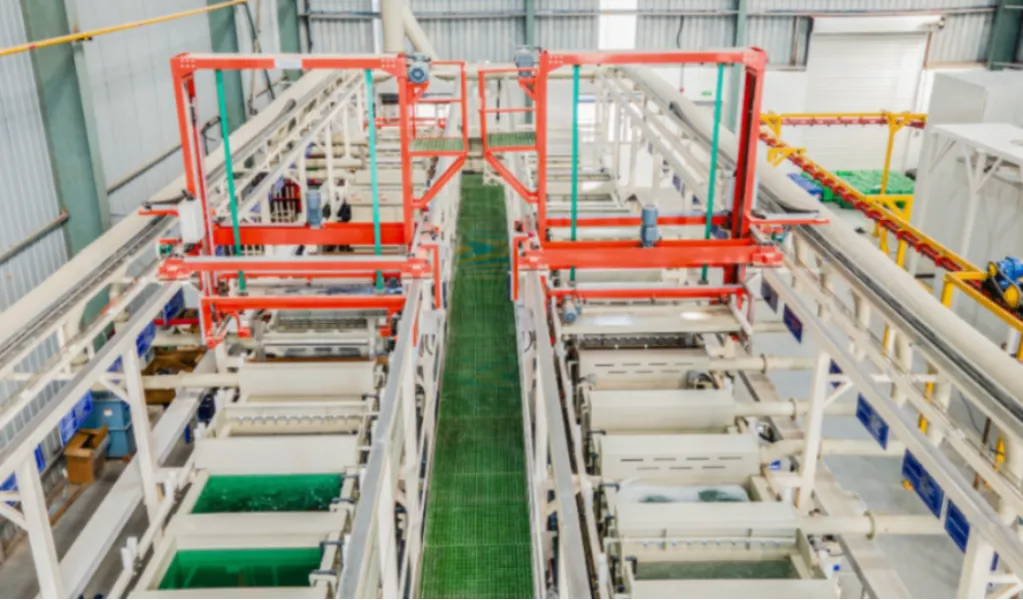
Fume extraction is often viewed as supporting equipment for an electroplating line. In practice, it needs to be considered during the earliest stages of plant layout because hood position, duct routing, fan capacity, air treatment, and make-up air can all affect how effectively emissions are captured.
A poorly designed Plating Line Fume Extraction System may consume considerable energy while still allowing fumes or mist to escape into the work area.
For plating facilities in Bangalore and industrial areas across Karnataka, avoiding common design mistakes can improve both plant functionality and maintainability.
Mistake 1: Designing Extraction After the Tanks Are Installed
Once tanks, cranes, structural supports, pipes, and electrical systems are installed, available duct routes become limited.
Extraction design should ideally be coordinated with the plating line layout.
This makes it easier to position capture points near emission sources while keeping ducts away from material movement and maintenance areas.
Mistake 2: Selecting the Fan Before Calculating System Resistance
A larger exhaust fan does not automatically create better extraction.
Airflow depends on the complete system, including:
- Hood design
- Duct diameter
- Duct length
- Bends
- Branch connections
- Dampers
- Scrubber resistance
- Stack arrangement
These components create pressure losses. Fan selection should therefore be based on the required airflow and calculated system resistance.
Mistake 3: Ignoring Capture Velocity at the Tank
The objective is to capture contaminated air before it spreads into the workplace.
A system can have high total airflow but perform poorly if the hood is incorrectly positioned or the air velocity at the source is inadequate.
Tank width, process temperature, emission characteristics, cross-drafts, hood configuration, and working access should be considered when determining the extraction arrangement.
Mistake 4: Using Unsuitable Construction Materials
Electroplating environments can be corrosive.
Ducts, hoods, fans, scrubbers, fasteners, supports, and related components need material compatibility appropriate to the extracted contaminants.
Using materials without considering chemical exposure can result in premature deterioration and increased maintenance.
Mistake 5: Forgetting Make Up Air
Air removed from a factory must be replaced.
If a large extraction system operates without adequate make-up air, negative pressure can develop within the building. This may interfere with extraction performance and affect doors, ventilation, or other air-moving systems.
The overall building ventilation strategy should therefore be considered alongside local extraction.
Mistake 6: Connecting Every Tank Without Process Assessment
Not every process tank necessarily requires identical extraction.
Emission characteristics differ according to chemistry, temperature, agitation, and operating conditions.
A process-specific assessment helps determine where extraction is required and how much airflow each point needs. This can avoid both under-extraction and unnecessary energy consumption.
Mistake 7: Neglecting Maintenance Access
Ducts accumulate deposits. Fans, scrubbers, dampers, nozzles, pumps, and mist-control components may require inspection and cleaning.
A Plating Line Fume Extraction System should provide practical access for maintenance rather than placing critical equipment where routine service becomes difficult.
Mistake 8: Treating the Scrubber and Fan as Separate Systems
Where a scrubber is required, it creates resistance within the exhaust path and must be considered when selecting the fan.
The duct network, scrubber, fan, stack, liquid circulation, and control system should therefore be engineered together.
AK Automation Systems works with industrial surface finishing installations where extraction needs to be coordinated with plating equipment and factory layout.
For Bangalore manufacturers planning a new plating facility or upgrading an existing line, the most useful approach is to review the chemical processes, tank dimensions, emission sources, line arrangement, duct routes, treatment requirements, and maintenance needs before equipment is finalized.
Effective fume extraction is not achieved simply by installing a powerful fan. It comes from controlling airflow from the process tank through capture, transport, treatment, and final discharge as one integrated system.
Keywords


