A coating that looks bright can still fail at a bore, edge, contact point or recessed surface. To choose the right electroplating application and machine, you need to connect the service duty to the coating system, then specify loading, current distribution, pretreatment, process control and inspection before comparing equipment.
Key takeaways
- Select zinc for sacrificial corrosion protection on steel fasteners and outdoor hardware.
- Specify coating thickness, coverage, adhesion, appearance, and inspection methods before buying equipment.
- Include cleaning, activation, rinsing, and waste handling in the process design.
- Test rectifier output and coating distribution on edges, recesses, and internal surfaces.
Match the coating to the service duty, not the appearance
Choose the coating by service duty, not shine. Zinc on steel provides sacrificial corrosion protection: it corrodes before exposed steel, making it suitable for fasteners, brackets and outdoor hardware. Nickel supplies barrier protection against humidity and mild chemicals while also improving appearance.
A phosphate conversion coating belongs beneath paint or oil, where it improves adhesion and delays under-film corrosion; it is not a decorative finish or a complete barrier by itself.
| Coating | Primary function | Choose it when | Key limitation |
|---|---|---|---|
| Zinc | Sacrificial corrosion protection | Steel faces humidity, salt or outdoor exposure | Damage consumes the zinc and exposes the substrate |
| Decorative nickel | Barrier protection and appearance | A part needs a smooth, bright finish with moderate corrosion resistance | Brightness does not prove thickness, adhesion or pore-free coverage |
| Hard chrome | Hard chrome wear resistance | Sliding, abrasive or dimension-critical surfaces need low wear | Poor coverage in recesses and inadequate preparation can cause peeling |
| Phosphate | Conversion layer beneath paint or oil | You need paint adhesion or temporary oil-held corrosion resistance | It is porous and needs the specified top finish |
For decorative corrosion performance, specify the complete stack rather than a thick chromium flash alone. Copper, semi-bright nickel, bright or high-sulfur nickel, microporous or microcracked nickel, and chromium distribute corrosion paths; the sequence and individual thicknesses determine whether the finish survives salt, humidity, chemicals and handling.
A bright surface can still fail quickly if recesses are thin, pores reach the substrate, or adhesion is poor.
Write a measurable coating specification before choosing equipment
Define the part, coating, electrical window and acceptance test before selecting a machine. A specification that says “uniform zinc” cannot reject a thin bore, a burned edge or poor adhesion.
Record these values for every part number:
- Base material, hardness and any hydrogen-embrittlement requirement
- Overall dimensions, deep holes, recesses, edges and surfaces that must be coated or masked
- Coating metal or conversion coating, coating thickness in micrometres and allowable thickness variation by measurement location
- Current density range in A/dm², bath temperature, process voltage and target ampere-hours
- Parts per load, maximum active surface area, rack or barrel loading pattern, production quantity and required cycle time
- Acceptance tests, including X-ray fluorescence or magnetic-induction thickness measurement, adhesion testing, visual limits, porosity, hardness and roughness
Rack and barrel loading create different acceptance risks:
| Option | Strength | Define before equipment selection |
|---|---|---|
| Rack plating | Better orientation, contact stability and coverage control | Fixture geometry, contact marks, masking, spacing and auxiliary anode positions |
| Barrel plating | Efficient for small, robust parts | Load mass, barrel fill level, part-to-part contact, tangling and edge-damage limits |
Overloading either system restricts solution access and current distribution. Underloading a barrel can cause excessive current density, burning and unstable contacts.
Size the rectifier for maximum active area multiplied by the specified current-density range, simultaneous loads and process voltage, with headroom for busbar, contact and solution losses. Control production with ampere-hours, then verify thickness at defined locations; a timer alone cannot prove deposited thickness.
Define any required post-plating hydrogen-relief bake by the applicable material and customer standard.
Treat pretreatment and rinsing as part of the coating process
Adhesion is decided before the part reaches the plating tank. Oil, scale, fingerprints and smut block metal-to-metal contact; the deposit then blisters or peels even when thickness meets the specification. Pretreatment must match the base alloy and selected deposit.
- Use descaling to remove oxide without changing dimensions or leaving residues. Descaling does not replace cleaning.
- Use alkaline cleaning for oil and process soil. Add electrocleaning when the alloy and approved chemistry allow it; excessive current can roughen or attack sensitive surfaces.
- Rinse fully, then use acid activation to remove oxide and reactivate the surface. Excessive acid attack can weaken adhesion and increase hydrogen uptake in high-strength steel.
- Apply masking to threads, contact faces, bores or sealing surfaces that must remain uncoated. Poorly sealed masking creates leaks, bare bands or trapped chemistry.
- Rinse again with sufficient spray or immersion coverage, including recessed features and rack blind spots. Never let an activated part dry before plating.
Rinsing is process control, not merely wastewater equipment. Counter-current stages, adequate overflow and conductivity monitoring limit drag-in between incompatible baths; contaminated rinse water carries cleaner or acid into the plating bath, causing pits, roughness and corrosion failures.
If the material or customer standard requires hydrogen-embrittlement relief, define the post-plating bake by that standard. Baking cannot repair unsuitable cleaning, excessive acid exposure or pre-existing susceptibility. Keep cyanide-bearing streams separate from acidic drainage to prevent hydrogen cyanide gas generation.
Control coverage across edges, recesses and internal surfaces
Choose rack plating for parts with deep recesses, bores or critical faces that need controlled orientation. Use barrel plating for small, robust components when low handling cost outweighs contact marks, edge damage and greater coverage variation.
| Loading method | Coverage advantage | Main risk |
|---|---|---|
| Rack plating | Fixed spacing, reliable contact and controlled orientation | Fixture shadowing, contact marks and masked areas |
| Barrel plating | Tumbling exposes multiple faces without individual fixturing | Part-to-part contact, tangling, lower effective current density and thin internal coverage |
Set the load to the machine’s actual envelope. An overloaded rack or barrel blocks solution access and starves recesses; an underloaded one raises current density, burns edges and destabilises contact. Map thickness on production-shaped parts, including corners, bores and internal surfaces, rather than relying on a flat test panel.
Reduce edge build-up with shields placed between the anode and protruding features. Fit current thieves to draw excess current from corners and outer edges. Use conforming anodes or auxiliary anodes to bring current into deep recesses and bores; position them from thickness mapping, not guesswork. Keep anode-to-part spacing consistent across the load.
Inspect rack tips, hooks, clamps and busbar joints before each run. Oxide, weak clamping force, undersized hooks or plating build-up creates resistance, arcing and intermittent coverage even when the rectifier displays the correct amperage. Clean contact points and validate the fixture at production load.
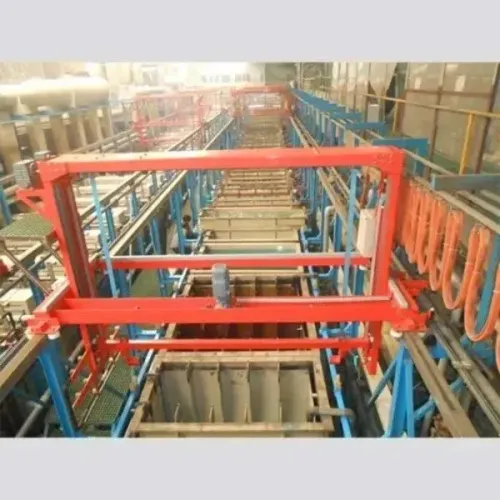
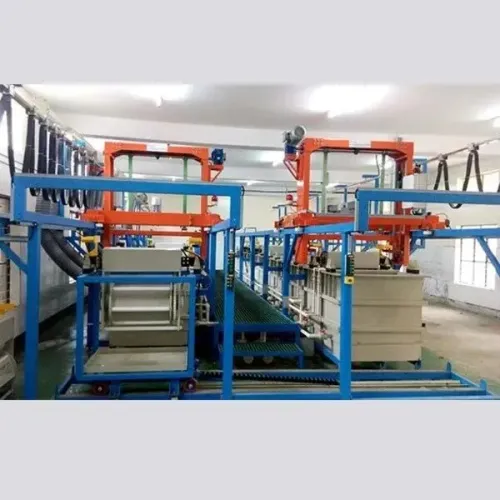
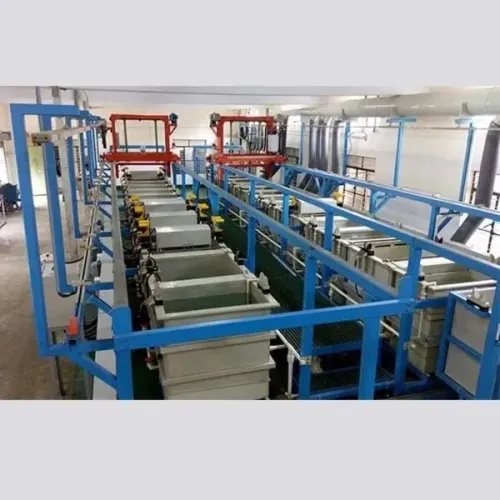
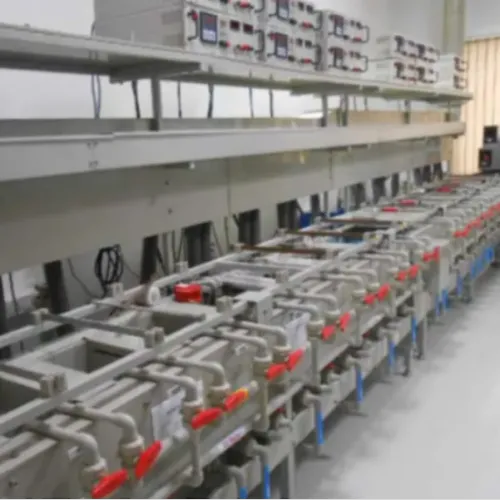
Validate the complete plating line, from rectifier output to inspection
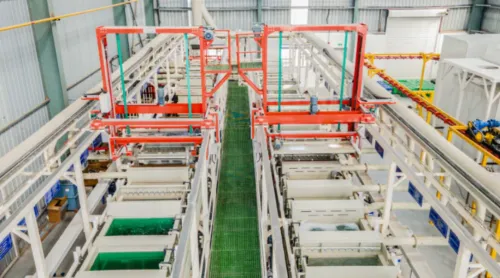
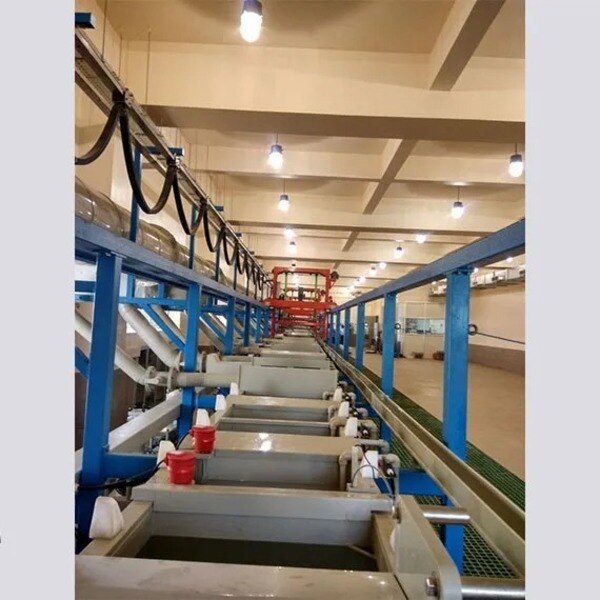
Approve an automated line only when measured coating results stay within specification across a full production load, not when the rectifier displays the programmed current. Validate ampere-hours, but also measure thickness because cathode efficiency changes with temperature, additive concentration, contamination and agitation.
- Check rectifiers against an independent calibrated meter at several current settings. Record voltage stability, polarity, ramp behaviour and alarm response.
- Measure contact resistance from busbar to rack tip under production clamping force. Clean oxidised tips, tighten joints and reject undersized hooks; intermittent contacts create low-current parts or arcing.
- Confirm anode-to-cathode spacing, rack geometry, shields, thieves and auxiliary or conforming anodes using thickness maps on edges, recesses, bores and flat areas.
- Validate agitation and filtration by checking flow at the plating zone, filter loading, return turbulence and air entrainment. Particles cause nodules, roughness and pits.
- Place temperature sensors in the active plating zone, then compare them with readings at the tank return. Verify temperature control and dosing records, chemical segregation, exhaust interlocks and spill-response systems.
- Run repeated loads at minimum, nominal and maximum production quantity. Inspect thickness, adhesion, appearance and defects using the specified gauge or cross-section method.
| Validation evidence | What it reveals | Corrective action |
|---|---|---|
| Thickness map | Local current-distribution failure | Alter spacing, shields or anodes |
| Ampere-hour versus thickness record | Efficiency or dosing drift | Investigate bath chemistry and temperature |
| Contact-resistance log | Rack, hook or busbar faults | Clean, tighten or resize contacts |
AK Automation Systems can include these measurement points in the line documentation, so acceptance testing reflects production rather than an empty-tank demonstration.
Related products
 | Nickel and chrome plating plants Nickel and chrome plating plants Electro nickel plating, also known as nickel electro-deposition, is becoming an increasingly popular process for a variety of different manufacturing... View product → |
 | Acid and alkali zinc plating plants Acid and alkali zinc plating plants Zinc Electroplating is one of the most common forms of electroplating and popular because of its relatively low cost, protective nature and... View product → |
Frequently asked questions
How do you choose an electroplated coating for an application?
Match the coating to service duty. Zinc provides sacrificial corrosion protection for steel, while nickel provides barrier protection against humidity and mild chemicals.
What belongs in an electroplating coating specification?
Define coating material, thickness, coverage, adhesion, appearance, allowable defects, test method, sampling plan, and acceptance limits before selecting equipment.
Why are pretreatment and rinsing part of the plating process?
Cleaning, activation, and rinsing remove oils, oxides, process residues, and drag-out that would otherwise cause poor adhesion, stains, contamination, or uneven deposition.
How do you achieve uniform plating on edges, recesses, and internal surfaces?
Control part orientation, racking, anode placement, current density, agitation, shielding, and solution flow, then validate coverage on representative test parts.
What should you validate across a complete plating line?
Check rectifier current and voltage, tank chemistry, temperature, filtration, rinsing, ventilation, wastewater controls, process records, and final inspection results.
Related products
 | Phosphating lines Phosphate coatings are often used to provide corrosion resistance, however, phosphate coatings on their own do not provide this because the coating... View product → |
 | Plating on plastics Plastic composite materials continue to be popular because of their combination of advantages: Plastics are light, corrosion-free and can be formed... View product → |