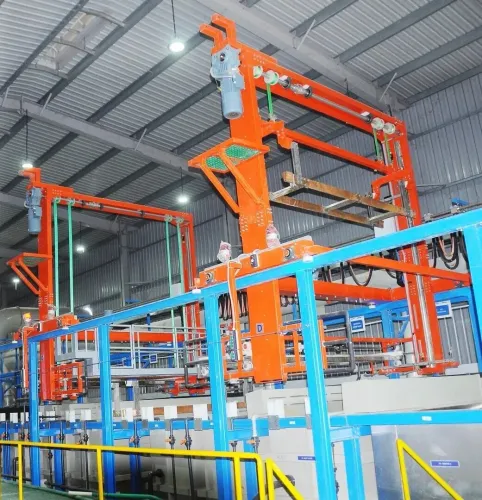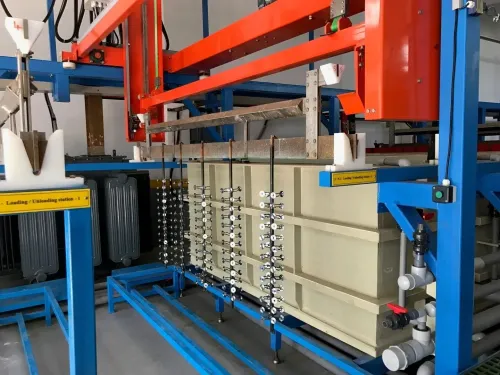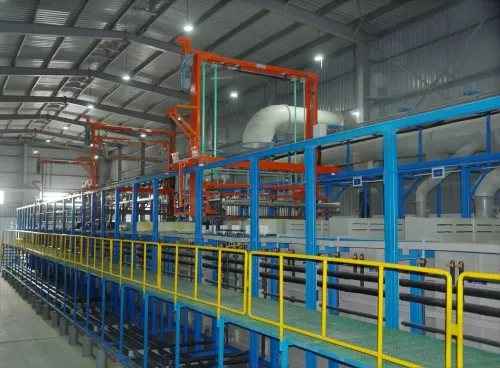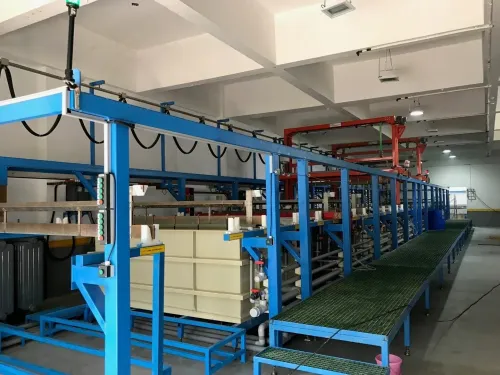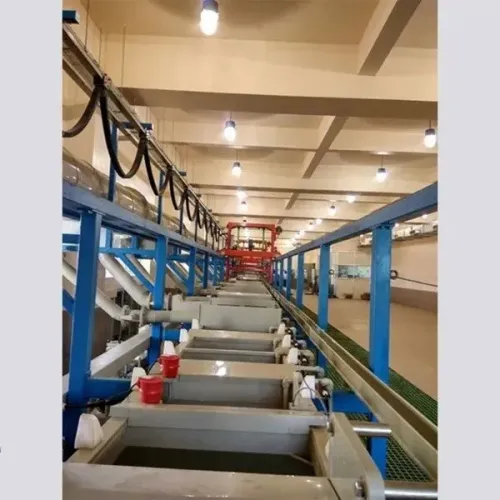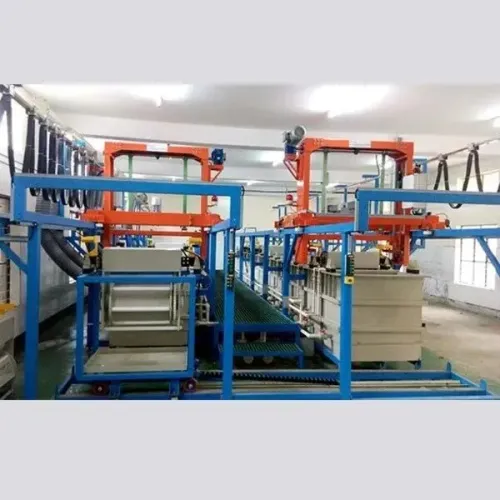
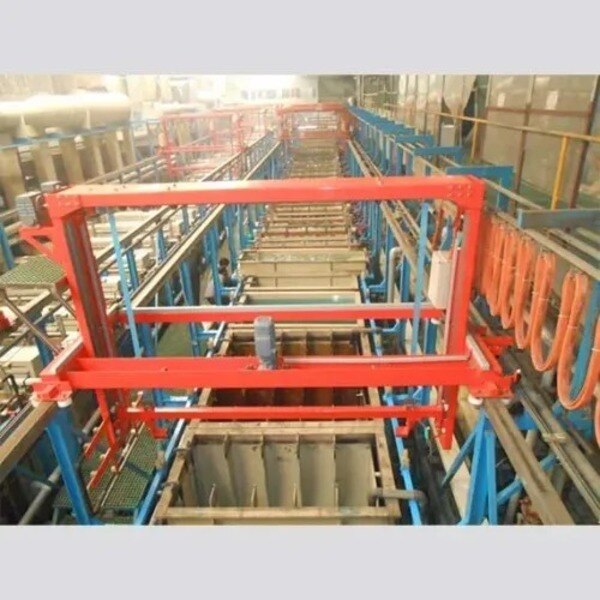
A phosphating line is a chemical-conversion plant whose performance depends on chemistry, part handling, rinsing, ventilation and effluent control—not simply on the number of tanks or conveyor speed. By comparing the process route, equipment, sizing calculations, installation scope and acceptance tests, you can assess whether a Bangalore supplier can deliver a production-ready line.
Key takeaways
- Define substrate, corrosion target and final finish before selecting tanks.
- Choose spray for exposed surfaces and immersion for complete part coverage.
- Size tanks from throughput, dwell time, drainage and loading—not floor space alone.
- Accept the line against bath tests, coating results, cycle time and safety checks.
What process should your phosphating line perform?
Specify the chemistry before you specify the tanks: an industrial phosphating line must match the substrate, required corrosion performance and final finish. The normal sequence is:
1. Alkaline cleaning removes oil, grease and shop soil. Poor cleaning leaves bare patches and weak adhesion.
2. Water rinsing removes cleaner carryover. Add surface activation or conditioning when the chemical supplier requires it for the substrate and coating system.
3. Phosphating converts the prepared surface. Spray iron phosphate commonly runs at about 40–70 °C; zinc phosphate at 45–60 °C; manganese phosphate often at 90–100 °C.
4. Post-rinse removes residual chemicals. Follow it with sealing or passivation when the specified system requires improved corrosion resistance or storage protection.
5. Dry the parts thoroughly, then apply paint or powder coating when the line feeds a painted finish.
| Chemistry | Purpose | Typical application |
|---|---|---|
| Iron phosphate | Thin pretreatment beneath paint | General paint and powder-coating preparation |
| Zinc phosphate | Heavier coverage and stronger paint adhesion | Higher corrosion performance under paint |
| Manganese phosphate | Wear resistance, controlled friction and oil retention | Mechanical parts, not conventional paint pretreatment |
Treat these as different chemistries, not interchangeable quotation options. Use the chemical supplier’s technical data sheet for concentration, dwell time and operating limits. A phosphating line is normally a chemical-conversion plant; install a rectifier only when electroplating, anodizing or electrocoat stages are integrated.
Should you choose spray, immersion or a combined line?
Spray suits high-volume sheet-metal parts and short cycle times when spray headers can reach every surface. Immersion or hoist handling suits heavy parts, irregular geometry and mixed batches, but air entrapment, drainage and contact marks demand control.
| Option | Best fit | Main checks |
|---|---|---|
| Spray | High-volume, repeatable sheet-metal parts | Nozzle access, filtration, pump capacity and blockage protection |
| Immersion or hoist | Heavy, irregular or mixed-batch parts | Air release, drainage time, tank dimensions and carrier access |
| Combined | Parts needing fast cleaning and deeper treatment | Spray cleaning followed by immersion phosphating or dip treatment |
A combined line is useful when spray cleaning removes soil quickly, then immersion reaches recesses that headers cannot reliably cover. It costs more floor space and handling complexity, so use it when geometry justifies both stages.
Define the substrate and required finish first. Select the chemistry next, then choose rack or barrel loading, handling method and line arrangement; do not accept a standard catalogue footprint. Compare the part envelope, rack or barrel capacity, tank dimensions, carrier access and allowable contact marks.
Check drainage time before fixing conveyor pitch, and confirm spray-zone coverage before approving nozzle positions. Ask for pump capacity, filtration rating and blockage protection in the quotation. A search for a phosphating line manufacturer near me should lead to these process questions, not locality alone.
How do you size the equipment for real production?
Start with the part envelope, not the supplier’s headline capacity. Record length, width, height, weight, drainage restrictions and allowable contact marks, then calculate:
- Takt time = available production minutes ÷ required parts; hourly throughput = 60 ÷ takt time.
- Rack or barrel loading density, carrier pitch and conveyor speed from the required load per carrier.
- Dwell time in every cleaning, rinse, activation, phosphate, sealing and drying zone.
- Tank working volume from liquid level, part displacement, spray demand and required residence time—not gross tank dimensions.
Compare these items against the quotation:
| Equipment | Check | Undersizing consequence |
|---|---|---|
| Pretreatment tanks, spray headers or immersion tanks | Coverage, working volume and access | Unclean areas or incomplete conversion |
| Pumps, heaters, dosing pumps, filtration and sludge removal | Flow, heat load, chemical control and solids capacity | Cold baths, blocked nozzles and unstable coating |
| Rinses, dryers, conveyors and PLC/HMI controls | Counter-current flow, conductivity, airflow and carrier load | Drag-out, water spots, wet parts and stoppages |
| Exhaust and safety interlocks | Hood geometry, tank arrangement and chemical hazards | Fume escape or unsafe operation |
Specify polypropylene, PVC-lined steel, stainless steel or FRP by chemistry and temperature; ordinary painted carbon steel fails in acidic phosphate zones. Require conductivity control and overflow on counter-current rinses. Design fume extraction around tank geometry, not a generic fan.
Wastewater planning must include oil separation where needed, pH neutralisation, phosphate precipitation, dissolved-metal removal, sludge thickening or dewatering and compliant disposal. A phosphating line for installation services in Bangalore should be sized against measured chemistry, utilities and effluent loads, not nominal parts per hour.
What does a Bangalore installation service need to include?
The installation contract should begin with a signed site survey documenting:
- Floor loading, clear height and access routes
- Part-flow distances, drainage points and chemical-storage space
- Electrical supply, water quality and available utility capacity
The scope should include the process-flow diagram, tank and conveyor layout, ventilation and duct routing, chemical-storage area, electrical single-line diagram, control-panel architecture, water and effluent connections, wastewater-treatment arrangement and safety interlocks. It should also identify tie-in points and who supplies each utility.
Do not confuse a fabricator with an integrator.
| Role | Scope | Risk if incomplete |
|---|---|---|
| Fabricator | Tanks, frames and conveyors | The hardware runs, but chemistry, exhaust, controls or effluent handling remain unresolved |
| Integrator | Chemistry, dosing, PLC/HMI controls, exhaust, utilities, wastewater and validation | One party coordinates process performance from design through handover |
A phosphating plant installation in Bangalore needs process integration, not just equipment delivery. AK Automation Systems is a Bangalore-based option when its proposal identifies your substrate, part geometry, throughput, chemistry and measurable acceptance criteria.
Ask any phosphating line supplier in Bangalore to guarantee coating weight or coverage, paint adhesion, corrosion-test performance, bath stability, water consumption and effluent quality. Locality helps breakdown response; it does not prove process capability or service coverage.
Related product
 | Phosphating lines Phosphate coatings are often used to provide corrosion resistance, however, phosphate coatings on their own do not provide this because the coating... View product → |
How should you commission and accept the line?
Mechanical completion is not process acceptance. Before handover, require evidence from chemical ramp-up, an empty-load trial and a production-load trial using representative parts and test panels.
1. Record spray-pattern coverage, immersion time and drying temperature. Check cleaner concentration, bath temperature, pH, free-acid and total-acid balance, accelerator level, contamination, rinse conductivity and coating weight. Define titration points, sample locations, sample frequency and sample handling in the commissioning plan.
2. Test dosing pumps, conductivity and pH instruments, low-level protection, dosing alarms and interlocks. PLC automation cannot correct unmeasured bath chemistry. Train operators to take samples, perform titrations, adjust chemicals, record results and respond to alarms.
3. Validate the finished coating on production parts and test panels. Use cross-cut paint-adhesion testing under ISO 2409, and run ASTM B117 corrosion testing when the customer specification or drawing requires it. Record wastewater-treatment trials and effluent results.
4. Make the acceptance certificate measurable: coating weight, paint adhesion, water consumption, bath stability and effluent quality must meet agreed limits. A tank count or conveyor speed is not a process guarantee.
The handover pack must include approved process parameters, as-built drawings, electrical schematics, PLC/HMI backups, chemical data sheets, maintenance schedules, spare-parts lists, wastewater-treatment records and training sign-off. Any phosphating line for installation services in Bangalore, including phosphating plant installation in Bangalore, should be judged against this evidence.
Frequently asked questions
What should a phosphating line perform before equipment is specified?
Define the substrate, required corrosion performance and final finish first. Then set the cleaning, rinsing, activation, phosphating, post-treatment and drying stages needed to achieve that result.
Should you choose a spray, immersion or combined phosphating line?
Choose spray when parts have accessible surfaces and continuous handling suits production. Choose immersion when complete coverage, cavities or complex geometries matter. Combine both when the product mix demands different treatment methods.
How do you size a phosphating line for real production?
Use parts per hour, loading pattern, conveyor speed, process dwell times, tank working volume, drainage time and peak production demand. Check space for loading, unloading, maintenance and chemical handling.
What should a Bangalore phosphating plant installation service include?
The service should cover process design, equipment manufacture or refurbishment, site installation, utilities, chemical-handling provisions, controls, operator training, documentation and after-sales support.
How should you commission and accept a phosphating line?
Run water trials, verify conveyor speed and dwell times, establish bath-control procedures, test coating results on representative parts, check safety systems and record performance against agreed acceptance criteria.
Keywords