Choosing a tank polymer by name alone is unsafe: hydrochloric acid, caustic soda and fluoride chemistry behave differently at different concentrations, temperatures and exposure times. By the end, you will be able to match material, construction and verification requirements to each plating-line duty and compare technically equivalent supplier quotations.
Key takeaways
- Match polymer selection to chemical concentration, temperature, exposure time and aeration.
- Treat PP, PVC and PVDF resistance charts as screening tools, not final approval.
- Design for liquid load, heating, agitation, lifting forces and thermal expansion.
- Specify inspection, commissioning checks and complete chemical-handling data in the RFQ.
Match the Polymer to the Actual Chemical Duty
A bath that is compatible at 20 °C can still destroy a tank at operating temperature. Check the actual concentration, temperature, exposure time, aeration and mechanical stress against the supplier’s chemical-resistance and temperature charts; ASTM D543 provides the immersion-practice framework. Treat the following ranges as screening guidance, not approval.
| Material | Practical continuous range | Suitable duties and cautions |
|---|---|---|
| PP | About 80–100 °C | Good candidate for hydrochloric acid, sulfuric acid, alkaline cleaners and cyanide solutions after concentration review. Polypropylene chemical compatibility falls with hot oxidizers, thermal cycling and welded stress. |
| PVC | About 60 °C | Economical and stiff for ambient hydrochloric acid, dilute sulfuric acid, rinses and some cleaning solutions. PVC chemical resistance does not justify hot concentrated acid, nitric acid, chromic acid, solvents or impact-prone service. |
| PVDF | About 120–140 °C | Preferred for hot aggressive acids, fluoride-containing solutions, halogens, oxidizing chemistry and low-extractables service. PVDF chemical resistance still needs review for hot concentrated caustic soda, amines and polar organic solvents. |
For a hydrochloric acid tank material, select PVC for an ambient, non-impact duty only after checking concentration; choose PP when temperature or handling loads rise, and review PVDF for hot, concentrated or highly aerated service. For nitric or chromic baths, do not approve PP or PVC from an acid-only chart: demand oxidizer-specific data.
Loaded tanks, welded seams and repeated heating reduce the allowable temperature, while fire planning remains separate because all three polymers can burn or decompose.
Choose the Tank Material by Process Stage and Function
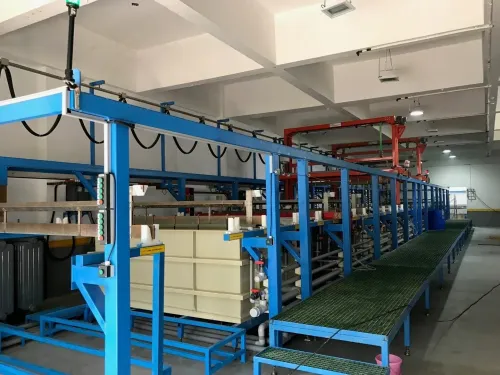
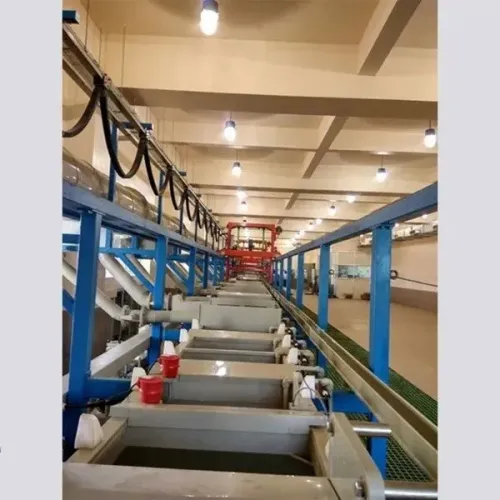
A soak cleaning tank usually favours welded PP: it handles hot alkaline cleaners and tolerates repeated loading better than PVC. Choose the electrolytic cleaning tank by bath temperature and electrode arrangement, not by polymer alone; the tank must leave room for bus bars, racks and grounded heaters.
| Stage | Practical choice | Function-based decision |
|---|---|---|
| Soak cleaning | PP; PVC only for cool, low-impact service | PP tolerates heat and rack impacts. Reject PVC when heat, solvents or rough handling could embrittle it. |
| Electrolytic cleaning | PP or PVDF | Match the polymer to the cleaner and temperature, then design electrode supports and clearances separately. |
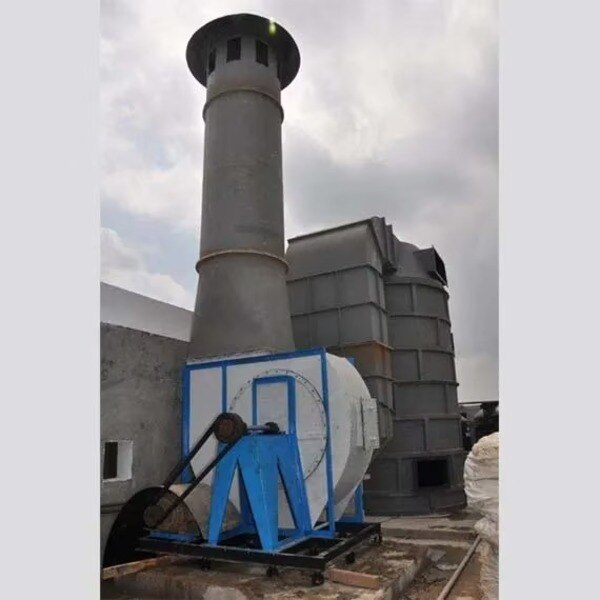
| Acid activation | PVC for ambient mild acids; PP or PVDF for hotter or more aggressive baths | An acid activation tank needs chemical compatibility and fume-control provisions, not merely a thick wall. |
| Zinc plating | PP is a common zinc plating tank material; PVDF suits severe chemistry or higher temperature | Specify the bath, additives, temperature and weld construction together. |
| Nickel or chrome plating | PP or PVDF, selected from the bath chemistry and temperature chart | Chrome baths demand particular scrutiny of oxidizer concentration and heat. |
| Rinsing | PVC for cool, clean water; PP for warm or contaminated rinses | Replace a “universal” rinse specification with one tied to drag-in and temperature. |
| Storage and waste | PP or PVDF; PVC for compatible ambient liquids | Size storage for residence time and waste tanks for sludge, temperature and treatment chemicals. |
The plastic tank does not prevent electrical shorts from racks, splashes or deposited salts. Size secondary containment for a failed tank, overflow, connected piping and displaced rack liquid, and verify that its material—not just a floor coating—resists the release.
Design the Tank for Load, Heat and Thermal Movement
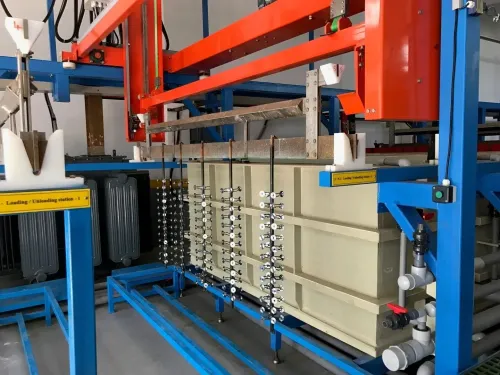
A full tank can weigh several tonnes once filled, and hydrostatic pressure is greatest at the bottom. Specify plastic tank wall thickness from liquid height, operating temperature, sheet modulus, support spacing, weld efficiency and long-term creep—not tensile strength alone. Check deflection before it becomes permanent.
- Build tank reinforcement into the design: use ribs, an external steel frame or composite supports to limit unsupported wall width and carry rack, pipework and maintenance loads.
- Allow the plastic and steel to expand independently. Slotted brackets, sliding supports and controlled clearances prevent a rigid frame from turning thermal movement into wall buckling or seam stress.
- Keep thermoplastic tank welding continuous, clean and accessible, with qualified procedures for sheet thickness, joint geometry and weld inspection. Do not place a seam beneath a concentrated support or heater attachment.
- In immersion heater tank design, support the heater independently, maintain the specified clearance from the tank wall, and provide a guard against rack impact. A heater hanging from the wall can distort the sheet and create a local hot spot.
Design the base for uniform support rather than isolated feet. Uneven settlement bends the bottom and transfers load into the corners. Account for filling, draining, temperature gradients and bath-level changes; a hot inner wall can expand while an externally restrained wall remains cool.
PVC solvent-cemented joints require specified solvent, cure time and joint geometry. Do not treat a piping joint as adequate for a large, hot process tank. Provide pipe expansion loops or flexible connections so connected equipment does not pull on the tank wall.
Inspect and Commission the Complete Chemical-Handling System
Do not charge hazardous chemicals until the tank, connected pipework, controls and secondary containment have passed a documented commissioning check. Apply the same discipline after a rebuild, liner repair, nozzle change or structural modification.
1. Compare the approved chemical schedule with the actual bath concentration, temperature, exposure time, aeration and mechanical loads. Record ASTM D543 compatibility evidence for the selected polymer; a room-temperature rating does not prove resistance to a hot, concentrated mixture.
2. Complete a plastic tank weld inspection. Check weld beads, corners, nozzles, seams and support interfaces for undercut, porosity, cracking, incomplete fusion and distortion. For PVC, record the solvent-cement type, joint geometry and cure time; do not assume a piping adhesive is suitable for a hot process tank.
3. Perform tank leak testing with a written test method, duration and acceptance limit. Inspect every drain, overflow, flange, valve connection and repaired area. For a PVDF liner, specify liner thickness, attachment method, edge sealing, holiday or leak testing, and the approved repair procedure.
4. Inspect external ribs, steel frames and anchors for clearance that permits thermal movement. A rigid connection between expanding plastic and steel can buckle the wall or load a seam.
5. Verify secondary containment against the credible release: failed tank, overflow, connected piping and displaced liquid from racks. Confirm chemical compatibility and inspect the floor, coating, sump and unverified liner before filling.
6. Run plating tank commissioning with water or an approved inert test liquid. Prove level alarms, temperature trips, pumps, extraction, interlocks, drains and emergency isolation, then record the signed results before introducing chemicals.
Compare Alternatives and Write a Technically Complete RFQ
The cheapest tank is not the lowest-cost choice if heat, oxidizers, solvents or long service life control the duty. FRP versus plastic tanks depends on chemical compatibility, stiffness, repairability and temperature; ask AK Automation Systems to compare those factors against the actual bath data, not just the material name.
| Option | Strengths | Main limitation |
|---|---|---|
| PP | Weldable, economical, good for alkalis and many plating baths | Creep and expansion increase with heat; oxidizing acids need verification |
| PVC | Good acid resistance and low cost at moderate temperature | Rigid, brittle when cold; continuous service is commonly limited near 60 °C |
| PVDF | Broad chemical resistance and higher temperature capability | High material and fabrication cost |
| FRP | High stiffness; useful for large tanks and some waste duties | Resin, laminate and liner chemistry must match the bath |
| Rubber-lined steel | Steel stiffness with replaceable chemical barrier | Lining damage exposes steel; inspect holidays and seams |
| Stainless steel | Strong and cleanable | Chlorides, acids and plating chemicals can cause pitting or contamination |
| Polyethylene | Tough and economical for selected storage or rinsing | Lower stiffness and temperature capability |
| PTFE-lined tank | Excellent resistance for severe chemistry | Expensive, difficult to fabricate and mechanically support |
- State chemical names, concentrations, temperature range, level, batch size and design life.
- Require drawings showing wall thickness, welds, ribs, steel frames, supports, nozzles, heaters and expansion gaps.
- Demand grade-specific compatibility charts, allowable temperature under load, creep basis and thermal-expansion allowances.
- Specify PP/PVDF welding or PVC solvent-joint procedure, cure time, inspection, leak test and repair method.
- Require material certificates, weld records, dimensional inspection, hydrotest results and a signed deviation list.
Frequently asked questions
How do you choose between PP, PVC and PVDF for a plating tank?
Compare the actual chemical concentration, operating temperature, exposure time, aeration and mechanical stress with the supplier’s resistance and temperature charts. Use ASTM D543 immersion practice as a testing framework, then obtain application-specific approval.
Why must tank selection account for process stage and function?
Storage, cleaning, pickling, plating, rinsing and waste treatment impose different chemical, thermal, hydraulic and mechanical duties. Select the material and construction details for the stage rather than specifying one polymer for the entire line.
What loads and temperature effects must a chemical tank design handle?
Check the full liquid load, tank supports, pumps, piping, heaters, agitators, workpieces, access covers and lifting forces. Allow for thermal expansion and contraction, especially when the tank heats from ambient temperature to operating temperature.
What should a technically complete plating-tank RFQ include?
State every chemical and concentration, operating and maximum temperature, liquid level, tank dimensions, duty cycle, aeration, agitation, heating, supports, connections, inspection documents and commissioning tests.